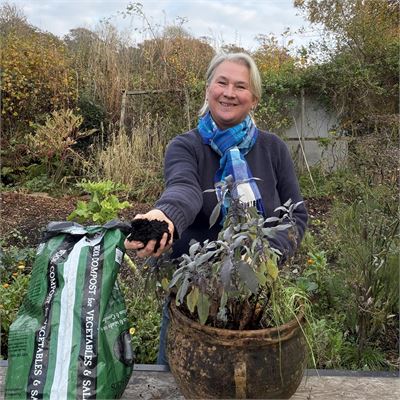
Caption: Mulching container herbs with Dalefoot compost

Caption: Preparing to mulch with wool fleece packaging
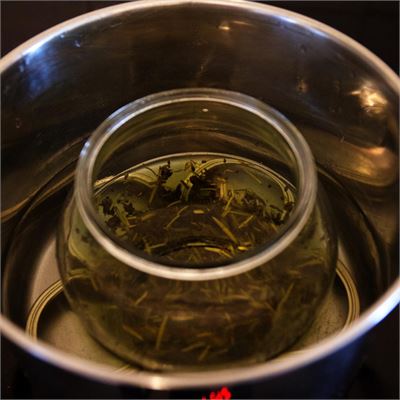
Caption: Infused herbal oil ready to strain
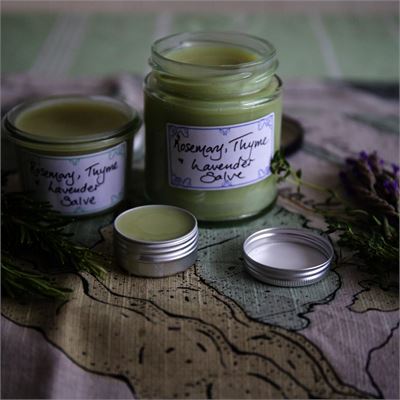
Caption: herb infused oil poured into containers and cooling
Some herbs come into their own in winter, and a little preparation can help keep you picking herbs throughout the colder months. Award-winning garden writer Stephanie Hafferty shares her tips on caring for herbs outdoors, what to sow indoors, how to dry herbs plus two very handy herbal recipes:
Rosemary, thyme, sage, winter savoury and bay - during the darkest months of the year, it is time for these perennial herbs to shine. Fragrant and flavoursome, they are a welcome ingredient in winter meals, drinks and the home apothecary. They also look (and smell) fabulous as seasonal decorations.
To ensure the longest life from your herb plants, get them winter ready. What you do will depend on how they are grown - in a container, or in the ground - and where: outside or undercover in a polytunnel or greenhouse.
Prepare herbs for the kitchen
First of all, cut bunches of herbs to store in the kitchen. Then you’ll always have homegrown herbs to hand ready for recipes. This saves having to go out in the dark, on a freezing cold night, in the sleet, seeking a sprig of rosemary for the roast potatoes by torchlight (yes, I speak from experience!).
Hang bunches of herbs tied with string in a dry, airy place until crisp. It’s important to choose somewhere where they won’t get contaminated by smoke, cooking smells, etc. A quick way to dry herbs is in a dehydrator. Many multi-cookers and air fryers have a dehydrator setting, which is ideal for herbs such as thyme, rosemary, mint, chives, parsley and tarragon.
Other ways to store herbs for the winter include making herb butters and oils, freezing and as herbal salts. (There are recipes in my book The Productive Garden.)
Time to mulch!
Whether they’re growing in pots or in the ground, mulching helps to feed plants and protect them through the long, cold months ahead.
For pots, remove any weeds that have snuck in, then mulch with a layer of compost. Compost mulches work very well because they feed the soil, protect it and provide a habitat for many insects to over winter in. Use a good compost such as homemade, or Dalefoot Wool Compost for Potting (red bag) or Veg (dark green bag). Remove and store any saucers for outside pots, then raise the pots up a little using flat stones or pot feet. This helps to prevent water logging and the pots freezing and cracking.
As an extra protection, top the compost with a layer of woolly fleece. The wool packaging that comes with frozen foods is ideal. Many grocery shops willingly give this away. Our local wholefood shop has a special crate outside where they put it for customers to help themselves. After removing (and recycling) the plastic cover, cut the fleece to fit the pot, making a slit half way across so that you can slide it snugly around the plant stem. This looks lovely, and in the spring birds will gather beakfuls to line their nests.
Mulch around herbs grown in the ground with good compost too. If you live in an area prone to very windy or wet weather (like me!) top the compost with an extra winter mulch of dried autumn leaves, grass clippings or the woolly fleece. This helps to prevent the compost from being washed or blown away, if the weather is very bonkers.
Protect your herbs
Bring any herbs that are not winter hardy under cover for the winter, if you haven’t done so already. Lemon verbena and parsley will winter happily in a polytunnel or greenhouse, whereas more tender herbs including pots of basil and lemongrass, need to be brought into a warm house.
Move containers to a sheltered spot for the winter, to prevent them from being blown over in storms.
Woody perennial herbs (rosemary, thyme etc), can usually withstand everything but the worst of wild winter weather. Very deep cold however can kill them, so it is worth keeping an eye on the weather forecasts and have some warm crop protection to hand, such as hessian sacking, 30gsm horticultural fleece, bubblewrap, or layers of straw.
Keep herbs cropping
Mint, chives, French tarragon, parsley and oregano slow down, or die back entirely, over winter. It is possible to keep them going year round, for fresh harvests. If they’re in the ground, dig up and pot on (Dalefoot Wool Compost for Potting compost is ideal for this). Grow on indoors on a sunny windowsill, or undercover outside (polytunnel, greenhouse, cloche, etc). If they’re undercover outside, remember to protect them against very cold weather with an extra layer of crop protection.
Sow coriander, dill, basil and chervil into pots on the windowsill for fresh leafy harvests.
Herb “foraging”
If you don’t have herbs growing at home, you may still be able to get herbs for free, even in urban areas. I have visited many community growing projects over the years and all of them have had well established woody herbs including rosemary, sage and thyme in their planters - all free to harvest.
Check the bargain areas in supermarkets for discounted cut and also potted herbs. I’ve spotted them for pennies.
Herbal recipes
One of my favourite herbs to use at this time of year is rosemary. It is a fabulous culinary herb, but it is also a wonderful healing ingredient for your homemade apothecary. Rosemary has many healing herbal properties including being anti-fungal, antiviral, and antiseptic. Traditionally used for helping to improve memory, a simmering pot of water and rosemary can help clear the head.
Here are two recipes using this lovely seasonal herbs: an infused oil, and then a healing salve made with the addition of dried thyme and lavender.
Rosemary infused oil
Simple to make, this oil has many uses. Massaged into the scalp, it can help promote healthy hair growth. You can use it as a massage oil, and because the ingredients are all culinary, it’s great to use in the kitchen too.
It is best to use dried rosemary to make the oil. This prevents any moisture from the fresh rosemary causing moulds or bacteria to form in the oil.
You’ll need rosemary and olive oil. Regular olive oil is fine, not the more expensive extra virgin.
Method 1 - cold infusion
Remove the leaves from the stems, and lightly crush them to release the fragrance. Half fill a clean jar with the dried rosemary, leaves and stems, then top up with the oil until the jar is full.
Replace the lid and put in a cupboard for 4 weeks, shaking every day, making sure that all the rosemary remains submerged in the oil. (It is a good idea to put it in a cupboard you open every day. Mine goes next to the tea bags.)
After 4 weeks, strain through a sieve lined with muslin into a clean jug. Pour this into a clean jar, replace the lid and label. Store in a dark place until you want to use it.
Method 2 - warm infusion
This is the quickest method and the one I use most regularly. A bain marie is a heatproof bowl (such as pyrex) placed over a pan of simmering water. The bowl should not touch the water.
Place one cup of rosemary (prepared as above) in a bain marie with two cups of olive oil. Simmer on a low heat with the pan lid on, for around three hours. Stir every 30 minutes, topping up the water as needed.
(Safety: Don’t leave the pan unattended. It is best placed on a back ring out of reach of children or curious pets.)
Or, use a slow cooker.
You’ll need a lidded preserving jar for this method, such as Kilner, Ball or Weck. It is very important that it is a jar designed for preserving, rather than a storage jar. Those could explode when simmering.
Half fill the jar with rosemary, top up with oil and replace the lid. Place in a slow cooker with hot water, up to about halfway up the jar, and simmer for three hours. Check the water level every 30 minutes.
After three hours, remove from the heat and leave to cool. Pour through a sieve lined with muslin into a clean jar. Label and store.
Rosemary, thyme and lavender infused winter salve for gardeners
This lovely salve is warming and good for aching hands after gardening in cold weather. It makes a welcome gift for gardeners too.
First, make some infused oil using the method above. I use roughly equal quantities of each herb ie: 1/3 cup of each to two cups of olive oil.
You’ll need:
100 ml infused oil
15g beeswax (or vegan alternative such as soy or candelilla)
A bain marie
Containers for storing
Grate the beeswax if not using pellets. Place in the bain marie over simmering water with the oil and stir until the wax has melted.
Remove from heat and carefully pour into the containers. Leave to cool for around 4 hours with the lids off (to prevent condensation from forming).
Seal and label.
About Stephanie:
Stephanie Hafferty is an award winning garden and food writer, expert no dig gardener, homesteader, edible garden designer and inspirational public speaker. She grows at her homestead teaching garden on half an acre in West Wales.
Stephanie writes for national and international publications, and is the author of three books. Her latest book The Productive Garden: An essential guide towards self-sufficiency was published in March 2026 by Frances Lincoln. It has been shortlisted for Practical Gardening Book of the Year 2026, and Stephanie herself has been shortlisted as Practical Journalist of the Year at the prestigious Garden Media Guild Awards.
Follow her journey on her blog, Instagram and You Tube
Website and blog : www.nodighome.com
Instagram: https://www.instagram.com/stephaniehafferty/
You Tube Channel: https://www.youtube.com/c/StephanieHaffertyNoDigHomesteading