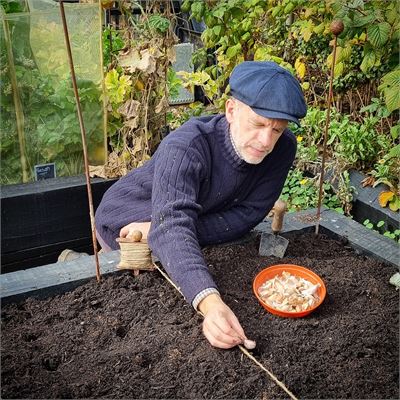
Caption: Garlic Planting
As autumn prepares to give way to winter, award-winning garden writer Ade Sellars shares his top practical jobs for the weeks ahead, from planting tulips and garlic to caring for your soil:
It’s hard to imagine, but it only seemed like yesterday we were in the sweaty vice-like grip of another heatwave. Hosepipe bans taunted our wilting blooms, growing veggies baked under an unforgiving sun, and gardeners were making offerings to appease the rain Gods. Yet, here we are now, in the depths of autumn, donning woolly jumpers and heavy coats in preparation of Jack Frost’s arrival. Clocks take a step back on the 26th of this month, meaning daylight hours finally succumb to the increasing darkness, bringing with it colder temperatures. On allotments and veg gardens, ripened pumpkins groan in anticipation of being harvested, hollowed and carved into the most gruesome of figures to celebrate the thinning of the veil on All Hollow’s Eve.
November arrives, and we pack our dearest off to parks and school fields to stand under the stars and huddle around fires that burn effigies of a man that could have changed history forever. As bonfires crackle, the sky explodes into an array of colour and spectacle, all to the excitement of gasping crowds.
Brisk country walks are taken, newly fallen leaves are kicked and we all raise a cup of homemade soup to celebrate glorious harvests. If you hadn’t realised by now, this is what
the passing of the baton looks like, where autumn hands responsibility over to winter. It’s also a time where gardeners will be preparing for the colder months ahead, whilst holding onto dreams of a new growing season and its alluring possibilities.
So, grab your wellies and scarf, head out outside and embrace the changing of the guard with a list of gardening jobs that will keep bodies warm and green spaces happy.
WINTER COLOUR
Exhausted and gone to seed, summer bedding plants have had their moment in the sun. Therefore, remove, clear weeds and freshen pots with Dalefoot’s Wool Compost for Potting. For winter colour, consider planting cyclamen, polyanthus and primrose. Whether it’s flower beds, borders, pots, containers or hanging baskets, these plants can fill your winter months with rich colour, seeing you right through to next spring.
PERENNIALS
Perennial plants will now be looking worse for wear. If garden wildlife has eaten the seeds, and you don’t want structure in your garden over the coming months, cut the plant to base and mulch with Dalefoot Composts Lakeland Gold. Not only will the compost help protect the rootball, but it will also retain moisture and help suppress weeds. Don’t cover over the plant, as the moisture can cause it to rot.
Increase your stock of summer flowering perennials by lifting, dividing and re-planting them where you want to see next year’s blooms. Water well and again apply a thick Lakeland Gold mulch around the plant to protect them the colder months ahead. As the soil is still warm, plants will have enough time to bed in.
BARE ROOT PLANTS
From November until March, bare root rose varieties are widely available to buy, this includes shrubs, trees and other plants. As they’re normally cheaper compared to potted varieties, there’s no excuse to plant out your favourite bloom in a flower bed or two.
Before planting, place your bare root roses in a bucket of water for at least half an hour, as this will allow them to re-hydrate. Dig the hole at least twice the size of the plant’s roots and about twelve inches in depth (length of a spade’s blade). When planting, ensure you use plenty of Lakeland Gold. Backfill, firm in well and water. Add a thick layer of compost around the plant to help protect roots from the winter weather.
If the ground isn’t waterlogged or frozen, get your bare root plants into the ground as soon as possible, otherwise the exposed roots will dry out. If you’re unable to plant them immediately, ‘heel in’. There, they can remain in a temporary site right up until spring, giving you ample time to get your final growing position prepared.
TULIP BULBS
Whether it’s swathes of tulips, container grown, or individual flowers dotted round your garden, November can be a good time to plant bulbs. Temperatures are dropping daily, so there’s no longer a threat of tulip fire infection. Avoid bulbs that show signs of decay, mould or damage, and plant three times to the depth of the bulb. Bulbs do not like to sit in water and can rot, so plant up with Dalefoot Composts Bulb Compost as this will ensure free-draining and encourage healthy, strong bulbs. You may want to cover the area with netting, to prevent mice and squirrels digging them up.
HARD-WOOD CUTTINGS
It’s not too late to take hard-wood cuttings, Plants include buddleia, vines and Cornus. Make a sharp cut just beneath a bud, and an angled cut across the top of the cutting. The angle ensures moisture runs off and doesn’t rot the cutting. Your cutting should be the length and width of a pencil. Place the straight end into a pot of compost, up to its middle. Try to use a square pot and place cuttings in each corner. Any heat will bounce off the corners of the pot and onto the cutting. Ensure the compost is damp, and place in a cold frame or greenhouse.
GARLIC
Keep the vampires at bay this Halloween and grow your own garlic. Before planting, ensure the chosen planting bed is free of weeds and large stones. Incorporate plenty of Dalefoot Composts Vegetables & Salad into the soil, tamp down and level the surface. Taking your garlic bulbs, divide them into cloves. There’s no need to remove the papery exterior as this will help protect them during planting. Plant cloves about 2-3cms deep with the pointy end of the clove facing up. Plant roughly 15cm apart and in rows 30cms apart. If you are unsure of measurements, simply use your hand trowel as a guide. The spade tends to be roughly 15cms in length, with the overall length roughly 30cms.
Once planted, water in well and label. Cover over planting area with netting, as this protects them from hungry birds thinking they’re worms. Keep the area weed free and the soil moist.
SOW
With the right protection, lettuce can be sown, grown and harvested. Consider varieties such as lamb’s lettuce, miner’s lettuce or micro greens. If you’re growing them in a greenhouse, try taking a bag of Dalefoot Composts Vegetables & Salad, lay it on the ground face up, remove the plastic front panel and sow your seeds into the bag. Label and water in well.
For an early spring harvest of broad beans, sow seeds into the ground. Ensure the area has had plenty of compost worked into the soil. Create a fine tilth, then sow double rows at six inches apart. Panting at nine inches apart to the depth of two inches. Cover the seeds, and water in well, marking the area where the seeds have been sown. Like garlic, to protect seedlings from hungry wildlife, cover over growing area with netting,
MAINTENANCE
If you have bare patches of soil in your flower beds or out on the veg plot, apply a thick layer of either Lakeland Gold or the Vegetables & Salads compost across the surface. Over the next few months, the compost will breakdown, leeching valuable nutrients into the soil. It will also protect plant roots, help to suppress weeds and improve soil structure.
Before the weather turns too cold give your lawn some attention by removing any thatch, aerate and give it a feed. Carry out any repairs and re-cut edges. Rake up fallen leaves as this will not only prevent pests from taking shelter, but it will also stop lawns being susceptible to the ‘browning off’ effect.
As plants and trees shed their leaves, you begin to see the blueprint of your garden. With a bare space, it’s easy to spot areas that need fixing and repairing. If you’re considering adding new features, such as arches, fences and paths, from now until spring is the ideal time. Most plants will have retreated back into the ground, so there’s little chance of damaging them as you work around the beds and borders.
BIO
I’m Ade Sellars the ‘Good Life Gardener’, and I am an award-winning garden writer, garden designer, presenter, and content producer, with a passion for growing my own food in my kitchen garden. As well as running my own gardening business, I produce tailored video content for gardening brands, flower shows and outdoor events, and I regularly deliver talks and demonstrations around the country. July this year I released my children’s debut fiction book, The Plot on the Hill: The Carrot Catastrophe.
The Plot on the Hill: The Carrot Catastrophe:
www.waterstones.com/book/the-plot-on-the-hill/ade-sellars/9781036990800
Website: www.adesellars.com
YouTube: www.youtube.com/@TheGoodLifeGardener
Instagram: adesellars